You’re scrolling through your inbox and there it is again — “Re:” sitting right before the subject line. Or maybe a friend just texted back “re your message” and left you wondering what they actually meant.
Here’s the short answer: “re” almost always means “regarding” or “about.” Slap it in front of an email subject, and it’s just telling you this message is a reply to something earlier. Simple as that.
But the meaning can shift a little depending on where you spot it — a work email reads differently than a quick text from a friend. Stick around, and we’ll walk through exactly how “re” shows up in emails, texts, and social media, with real examples so you never have to second-guess it again.
What Does Re Mean in Text?
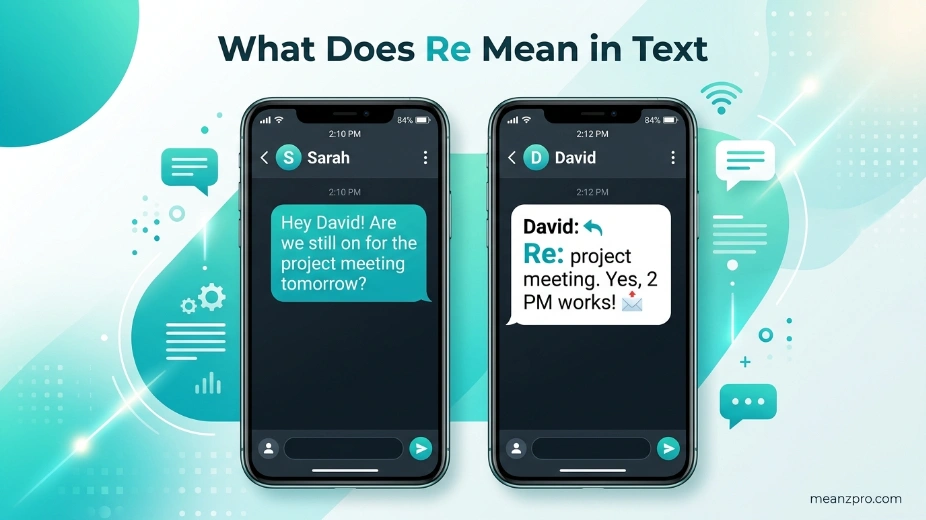
In text conversations, re is most commonly used as a shortened way of saying “regarding” or “about.” It points the reader toward a specific subject instead of introducing a new one.
For example:
“Re tomorrow’s meeting, I’ll be there at 10.”
Here, re simply means “about tomorrow’s meeting.”
Many people also notice “Re:” at the beginning of an email subject line. In that situation, it shows that the email belongs to an ongoing conversation rather than starting a new one.
Although it appears in digital communication every day, re is not considered a trendy text slang term. It’s a long-established abbreviation that continues to be useful because it’s short and instantly recognizable.
What Does Re Stand For?
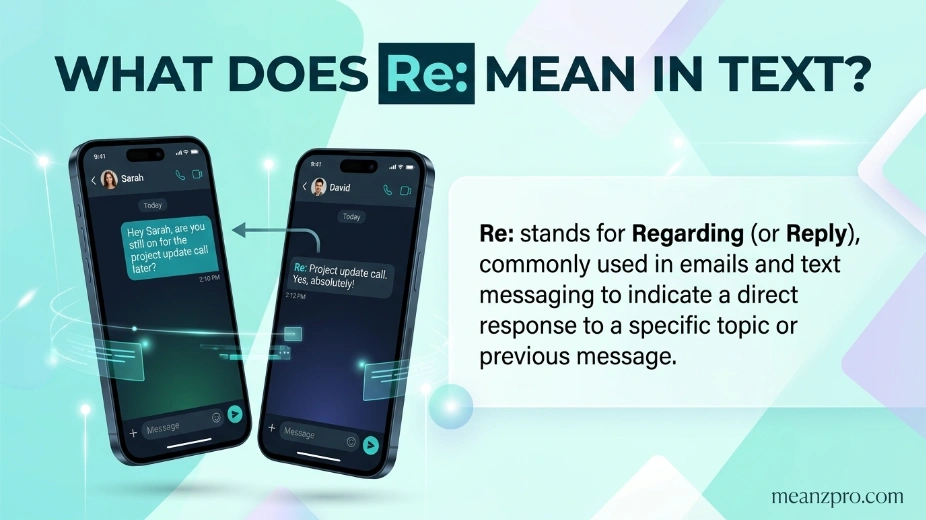
Unlike many chat acronyms, re does not stand for multiple words.
It comes from the Latin word in re, which means “in the matter of” or “concerning.” Over time, English speakers shortened this to simply “re,” using it to mean “regarding” or “about.”
Because it saves space while remaining clear, it has become a standard part of emails, letters, and many forms of online writing.
Quick Answer
What does re mean?
Re means “regarding” or “about” in written communication, especially in email subject lines. On TikTok, Snapchat, Instagram, WhatsApp, and text messages, people may also see “Re:” to indicate a reply to an earlier message or topic.
Key Takeaways
- Re is an abbreviation rather than modern internet slang.
- It is not offensive.
- It is commonly used by students, professionals, email users, and people chatting online.
- Its meaning changes slightly depending on whether you’re reading an email, message, or comment thread.
Why Do People Use Re?
People use re because it’s quick and keeps conversations organized.
Instead of writing “about” or “regarding” every time, they can type two letters and immediately show the topic they’re referring to.
Younger users occasionally include it in chats when discussing a previous message, while office workers, teachers, and students frequently use it in emails and written discussions where clarity matters.
Where People Use Re
TikTok
Users sometimes write “re your last video…” when commenting on a creator’s previous post.
Example:
“Re your skincare routine, which moisturizer do you use?”
Snapchat
Friends may use it when continuing a conversation from earlier in the day.
Example:
“Re what you said earlier, I totally agree.”
It often appears in DMs when someone wants to return to an earlier topic.
Example:
“Re our weekend plans, Saturday works better.”
Group chats sometimes use re before discussing a shared event or announcement.
Example:
“Re Friday’s dinner, should we book a table?”
SMS
People occasionally use it in everyday texting when referencing an earlier discussion.
Example:
“Re your question, the answer is yes.”
Real Chat Examples
Text Conversation
A: Did you see my message?
B: Re your question, I’m free after 6.
TikTok Comment
A: Re your latest recipe, I’m making it tonight.
Snapchat Chat
A: Re yesterday’s game, that ending was wild.
B: I still can’t believe it.
Instagram DM
A: Re our photos, can you send me the originals?
B: Sure, give me a minute.
Gaming Chat
A: Re tonight’s raid, who’s joining?
B: I’ll be online at eight.
Friend Conversation
A: Re the concert, did you buy tickets?
B: Not yet.
Family Text
A: Re dinner tomorrow, should I bring dessert?
B: Yes, that would be great.
School Group Chat
A: Re the science project, who’s presenting first?
B: I think Emma is.
Work Chat
A: Re the client call, the meeting moved to 2 PM.
B: Thanks for the update.
Travel Planning
A: Re our road trip, are we leaving early?
B: Around 7 AM.
Shopping Chat
A: Re those shoes, they’re finally on sale.
B: Perfect timing!
How to Reply When Someone Says “Re”
Casual Replies
- “Got it.”
- “Thanks for letting me know.”
- “Sounds good.”
- “I understand.”
- “I’ll check it out.”
Friendly Replies
- “Thanks for bringing that up!”
- “I was thinking the same thing.”
- “Great point!”
- “Happy to help.”
- “Let’s talk more about it later.”
Is Re Rude or Offensive?
No. Re is completely neutral and carries no rude or offensive meaning.
It’s appropriate for school assignments, workplace emails, professional messages, and everyday conversations. Since it’s a standard abbreviation rather than a piece of internet slang, most readers recognize it without misunderstanding.
Who Uses This Term?
People of many ages use re, although they may encounter it in different places.
- Gen Z often sees it while using messaging apps or replying in online conversations.
- Millennials commonly use it in workplace emails and digital communication.
- Gamers and social media users may use it when referring back to an earlier discussion or message thread.
Origin of the Term
The abbreviation re has existed for centuries and predates the internet by a very long time. It comes from the Latin expression in re, meaning “in the matter of.”
As business letters evolved into email, the abbreviation naturally carried over into electronic communication. Email programs later popularized the familiar “Re:” subject line, making it one of the most recognized abbreviations on the internet. Although many people assume it means “reply,” its historical roots point to its original meaning of “regarding.”
Other Meanings of Re
Depending on the context, re can have several unrelated meanings.
- In email subjects, it marks a reply or ongoing conversation.
- In music, Re is the second note in the solfège scale (Do, Re, Mi).
- In legal or business documents, it means regarding or concerning.
The surrounding conversation usually makes the intended meaning obvious.
Common Mistakes People Make About Re
- Assuming re is a modern texting acronym when it has existed long before smartphones.
- Believing Re: officially stands for “reply” in every situation.
- Thinking it should always be written in capital letters.
- Confusing it with unrelated abbreviations that happen to use the same two letters.
Related Internet Slang Comparison
| Term | Meaning | Type | Common Use |
|---|---|---|---|
| Re | Regarding/About | Abbreviation | Referring to a topic |
| IDK | I Don’t Know | Chat acronym | Expressing uncertainty |
| IDC | I Don’t Care | Chat acronym | Showing indifference |
| IMO | In My Opinion | Chat acronym | Sharing an opinion |
| TBH | To Be Honest | Chat acronym | Giving an honest statement |
| NGL | Not Gonna Lie | Chat acronym | Introducing a truthful remark |
| FR | For Real | Text slang | Showing agreement or seriousness |
| SMH | Shaking My Head | Internet slang | Reacting to disappointment |
| BRB | Be Right Back | Chat acronym | Saying you’ll return shortly |
Unlike the other entries, re focuses on introducing or referring to a subject rather than expressing an emotion or action. It functions more like a writing shortcut than a typical social media abbreviation.
Why This Slang Remains Popular
Even though re isn’t a new expression, it continues to fit naturally into today’s fast-paced messaging habits. People appreciate shortcuts that communicate a clear idea without adding unnecessary words. Whether someone is sending an email, participating in online messaging, or commenting on social platforms, this small abbreviation keeps discussions organized while taking almost no effort to type. Its simplicity has helped it remain relevant across changing communication styles.
Frequently Asked Questions
Does “re” always mean “reply”?
No. It originally means “regarding” or “about.” In emails, people often connect it with replies because “Re:” usually appears in reply subject lines.
Why do emails begin with “Re:”?
Most email apps automatically add “Re:” when you reply to an existing email. It helps keep related messages together in the same conversation.
Is “re” a texting abbreviation?
Yes. You’ll see it in text messages, emails, and other online conversations. Its meaning depends on the context, but it’s commonly used to refer to a topic or previous message.
Should I use “re” in professional emails?
Yes. It’s a standard and widely accepted abbreviation in business, school, and other professional communication when referring to a specific subject.
Can “re” have different meanings?
Yes. In most cases, it means “regarding” or marks an email reply, but it can also refer to the musical note “Re” in the solfège scale.
Is “re” popular on social media?
Yes, although it’s more common in direct messages and comment threads where people are referring back to an earlier post or conversation.
Do people pronounce “re” out loud?
Sometimes they do. Some people say “ree,” while others simply say “regarding” because it sounds more natural in conversation.
Conclusion
Re is a simple abbreviation that usually means “regarding” or “about,” while “Re:” in email subject lines identifies an ongoing conversation. You’ll come across it in text messages, WhatsApp chats, Instagram DMs, Snapchat conversations, TikTok comments, and professional emails. Since it’s clear, neutral, and widely recognized, it’s suitable whenever you want to refer to an existing topic without using extra words.
Discover More Post
What Does HY Mean in Text? 2 Common Meanings Explained 2026

Dexie is a professional content writer and language researcher with 8+ years of experience in English language, internet slang, texting abbreviations, grammar, and SEO content writing.
As the lead author at MeanzPro, Dexie creates well-researched, easy-to-understand content that helps readers learn modern English, social media slang, and everyday communication. Every article is written with accuracy, clarity, and Google’s Helpful Content guidelines in mind.